

IDENETY AI Intelligence Suite
Written by the engineers who built our real-check scanning tools
Most businesses assume their IT is reasonably secure. They have antivirus. They have a firewall. They pay someone to handle IT.
What they don't know is what their domain is broadcasting to the internet — and to attackers — right now.
IDENETY Zone Intelligence is our newest proprietary tool. It's a real-time AI-powered domain security scanner that checks six critical security categories in under 60 seconds, scores your posture from A to F, and calculates your estimated risk exposure in dollars. No signup. No sales call. Just the truth about your domain.
Here's what it checks, what we've found scanning hundreds of San Antonio businesses, and why the findings matter.
What Zone Intelligence Scans
Zone Intelligence runs six categories of real checks against your domain — not simulations, not estimates. Every finding is verifiable.
1. Email Authentication (DMARC, SPF, DKIM)
Email authentication is the foundation of email security. Without it, anyone can send email that appears to come from your domain — your customers, your vendors, your employees.
DMARC (Domain-based Message Authentication, Reporting & Conformance) tells receiving mail servers what to do with email that fails authentication. Without a DMARC policy, spoofed emails from your domain land in inboxes.
SPF (Sender Policy Framework) specifies which mail servers are authorized to send email from your domain. Without it, any server can send as you.
DKIM (DomainKeys Identified Mail) adds a cryptographic signature to outgoing email that proves it wasn't tampered with in transit.
What we find: 67% of scanned San Antonio business domains have no DMARC policy. 41% have SPF misconfigurations. DKIM is missing or broken on 58% of domains.
2. DNS Infrastructure
Your DNS records are public. Attackers read them before they attack you. Zone Intelligence checks for:
- Wildcard DNS records — catch-all entries that can be abused to create subdomains for phishing
- CAA records — specify which certificate authorities can issue SSL certificates for your domain
- NS record configuration — nameserver redundancy and security
- A record exposure — what IP addresses your domain resolves to and what that reveals
What we find: 91% of scanned domains have no CAA records. 34% have wildcard DNS entries with no documented business purpose.
3. HTTPS & Certificate Security
HTTPS is table stakes — but the details matter. Zone Intelligence checks:
- HTTP-to-HTTPS redirect (does your site force secure connections?)
- SSL certificate validity and expiration
- TLS version support (are you still accepting TLS 1.0/1.1?)
- HSTS (HTTP Strict Transport Security) — does your site tell browsers to always use HTTPS?
What we find: 28% of business websites don't properly redirect HTTP to HTTPS. 71% have no HSTS header. Expired or near-expiring certificates are found on 12% of scanned domains.
4. Security Headers
Security headers are HTTP response headers that tell browsers how to handle your site's content. They're free to implement and prevent entire categories of attacks.
Zone Intelligence checks for:
- Content-Security-Policy — prevents cross-site scripting (XSS) attacks
- X-Frame-Options — prevents clickjacking
- X-Content-Type-Options — prevents MIME-type sniffing attacks
- Referrer-Policy — controls what information is sent in the Referer header
- Permissions-Policy — controls browser feature access
What we find: 89% of scanned business websites are missing three or more critical security headers. Most have none at all.
5. Admin Panel Exposure
Zone Intelligence probes common admin paths to see if your administrative interfaces are publicly accessible. This includes WordPress admin, cPanel, Plesk, phpMyAdmin, and dozens of other common management interfaces.
Exposed admin panels are a primary attack vector. Attackers use automated tools to find them and then attempt credential stuffing, brute force, and known vulnerability exploitation.
What we find: 23% of scanned domains have at least one admin interface publicly accessible without additional authentication controls.
6. Web Presence & SEO Signals
Zone Intelligence also checks your web presence signals — not because they're security issues, but because they affect your business:
- LocalBusiness schema — does Google understand your business type, location, and hours?
- Open Graph tags — do your pages display correctly when shared on social media?
- Canonical tags — are you telling search engines which version of your pages to index?
- Sitemap — can search engines find and crawl all your pages?
- Google Maps embed — is your location verifiable on your website?
What we find: 76% of scanned business websites are missing LocalBusiness schema. 61% have no sitemap. These aren't security issues, but they cost businesses real money in lost search visibility.
The Zone Intelligence Scoring System
Every scan produces a score from 0–100 and a letter grade:
| Grade | Score | What It Means |
|-------|-------|---------------|
| A | 90–100 | Strong posture — minor gaps only |
| B | 75–89 | Good baseline — a few important items to address |
| C | 60–74 | Moderate risk — several significant gaps |
| D | 45–59 | High risk — multiple critical exposures |
| F | Below 45 | Critical — immediate action required |
The score is a simple average across the six categories. Every finding is weighted by severity — critical findings (like missing DMARC) carry more weight than informational findings.
Risk Exposure Calculation
Zone Intelligence calculates an estimated risk exposure in dollars based on your findings:
- Critical findings contribute $120,000 each to the exposure estimate
- High findings contribute $45,000 each
- Base exposure of $25,000 applies to any domain with findings
- Maximum cap of $850,000
These figures are based on published breach cost data from IBM, Verizon, and the Ponemon Institute. They're not guarantees — they're estimates of what a breach exploiting your specific gaps could cost.
The Zone Intelligence Poster
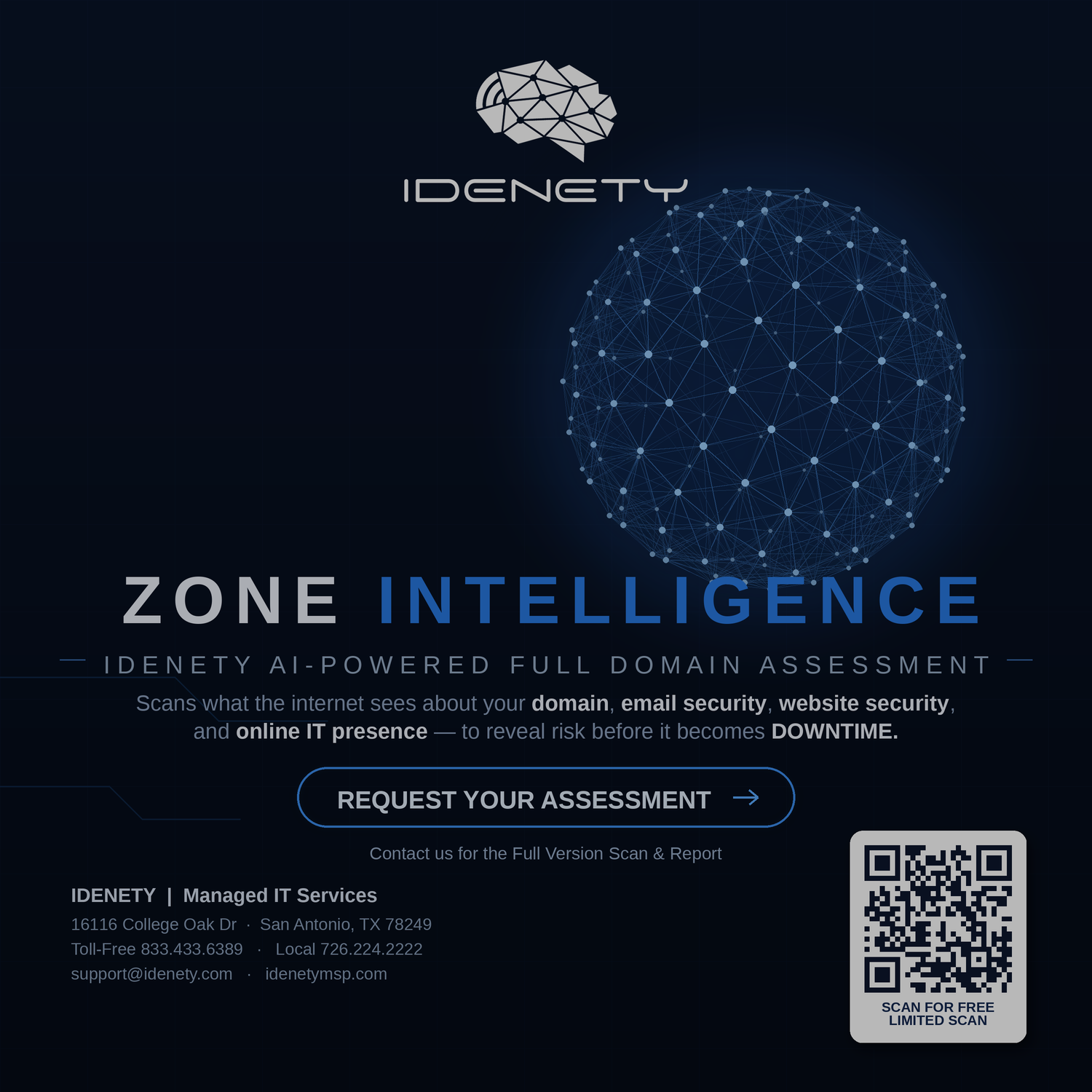
We created the Zone Intelligence Poster as a reference guide for business owners and IT teams — a one-page summary of what we scan, how we score it, and what the findings mean.
[](/api/poster-download)
[Download the Zone Intelligence Poster (PNG)](/api/poster-download) — print it, share it with your team, or use it as a reference when reviewing your scan results.
What to Do With Your Results
If you run a Zone Intelligence Scan and get a C, D, or F grade, here's the priority order for remediation:
- Fix DMARC first. A missing or permissive DMARC policy means your domain can be spoofed. This is the highest-impact, lowest-cost fix available. A properly configured DMARC policy takes about 30 minutes to implement.
- Fix SPF. Make sure your SPF record includes all legitimate sending sources and ends with `-all` (hard fail) rather than `~all` (soft fail).
- Add security headers. Most web servers can add security headers with a few lines of configuration. This takes an hour and eliminates entire attack categories.
- Audit admin panel exposure. If Zone Intelligence found exposed admin interfaces, restrict access by IP address or add additional authentication.
- Add CAA records. This takes five minutes and prevents unauthorized SSL certificate issuance.
- Fix HTTPS redirect and HSTS. If your site isn't forcing HTTPS, fix that immediately.
How IDENETY Uses Zone Intelligence
Zone Intelligence is the starting point for every IDENETY client engagement. Before we recommend anything, we scan your domain and show you the objective findings. No guessing, no assumptions — just data.
We also use it for ongoing monitoring. Domains change. DNS records get modified. Security headers get accidentally removed during website updates. Zone Intelligence lets us catch these regressions before attackers find them.
For prospective clients, it's the fastest way to get an honest picture of where you stand. Run the scan, see your score, and if you want to talk through the findings with one of our engineers, book an assessment. We'll walk through every finding, explain what it means for your specific business, and give you a prioritized remediation plan — whether you engage us or not.
[Run Your Zone Intelligence Scan →](/scan)
Download this article as a PDF
Includes IDENETY Zone Intelligence branding · Shareable with your team
See how your network actually scores
Our AI Zone Intelligence Scanner checks your domain for the exact vulnerabilities covered in this article — in under 60 seconds. No signup required.

Contact Us
Services


